
How Advanced Excel Training Enhances Data Analysis and Reporting
In today’s data-driven workplace, the ability to interpret numbers quickly and present insights clearly is no longer optional. Advanced Excel training plays a critical role in helping professionals transform raw data into meaningful reports. Whether you work in finance, operations, marketing, or academia, mastering structured tools for data analysis in Excel can significantly improve accuracy, speed, and decision-making quality.
This blog explains how advanced Excel capabilities improve data analysis and reporting, addresses common skill gaps, and explores practical, real-world applications across industries.
Why Data Analysis and Reporting Skills Important Today
Every organization generates data, sales numbers, customer details, operational metrics, budgets, forecasts, and performance KPIs. But collecting data is only the first step. The real value lies in interpreting and presenting it effectively.
Common Challenges Professionals Face:
- Difficulty analyzing large datasets efficiently
- Manual and repetitive reporting tasks
- Errors caused by inconsistent formulas
- Limited knowledge of analytical functions
- Struggling to present insights clearly to stakeholders
Without structured training, many professionals rely on basic spreadsheets, which leads to time-consuming processes and inconsistent outcomes.
This is where advanced Excel training bridges the gap, equipping learners with structured techniques for smarter analysis and professional reporting.
What Is Advanced Excel Training?
Advanced Excel training goes beyond basic formulas and formatting. It focuses on tools and techniques that enable deeper analysis, automation, and structured reporting.
Key components typically include:
- Advanced formulas (INDEX-MATCH, XLOOKUP, IF, SUMIFS)
- Pivot Tables and Pivot Charts
- Data validation and cleaning techniques
- Conditional formatting
- Power Query and Power Pivot
- Dashboard creation
- Basic automation with macros
The objective is straightforward: empower users to progress beyond basic data entry tasks and develop the ability to analyze, interpret, and transform raw information into meaningful insights that support smarter, data-driven decisions.
How Advanced Excel Improves Data Accuracy
Accuracy is the foundation of reliable business reporting in Excel. Small formula mistakes or inconsistent formatting can lead to incorrect conclusions.
1. Structured Data Validation
Advanced Excel tools allow you to:
- Restrict incorrect data entries
- Standardize formats
- Prevent duplicate records
This reduces human errors significantly.
2. Logical and Nested Functions
Instead of manual calculations, advanced formulas automate logic-based decisions. For example:
- IF statements categorize data automatically.
- SUMIFS calculates totals based on multiple conditions.
- INDEX-MATCH retrieves precise information from large datasets.
These techniques enhance both precision and consistency in data analysis in Excel.
3. Error-Handling Functions
Functions like IF-ERROR prevent reports from showing confusing errors. This is especially important when presenting reports to management.
With structured training, professionals learn how to create reliable, repeatable systems, not just spreadsheets.
Using Excel Functions for Better Data Analysis
Many professionals use Excel only for basic calculations. However, advanced formulas unlock deeper analytical power.
Essential Advanced Excel Skills for Analysis:
Lookup Functions
- VLOOKUP and XLOOKUP for retrieving data
- INDEX-MATCH for dynamic referencing
These are widely used in finance reconciliation, HR databases, and inventory tracking.
Conditional Aggregation
- SUMIFS
- COUNTIFS
- AVERAGEIFS
These functions help analyze trends, such as:
- Monthly sales performance
- Department-wise expenses
- Region-wise revenue growth
Data Cleaning Tools
Power Query simplifies:
- Removing duplicates
- Splitting columns
- Transforming raw data into structured tables
These tools are essential when dealing with large operational datasets.
By developing strong advanced Excel skills, professionals can handle complex data structures confidently.
Improving Reporting with Pivot Tables and Dashboards
One of the biggest advantages of advanced Excel is improved reporting clarity.
What Are Pivot Tables?
Pivot Tables summarize large datasets into meaningful reports. Instead of scrolling through thousands of rows, you can instantly:
- Group sales by region
- Compare monthly revenue
- Track employee performance
- Analyze expense categories
They are essential for effective business reporting in Excel.
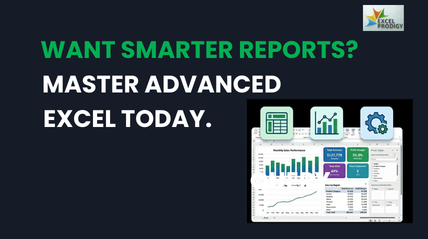
Creating Excel Dashboards
Dashboards combine charts, tables, and KPIs into one visual interface. With proper Excel data visualization, reports become:
- Interactive
- Easy to interpret
- Visually engaging
- Decision-focused
Using slicers and timelines, stakeholders can filter data instantly.
Well-designed Excel dashboards reduce the need for lengthy explanations. The numbers speak for themselves.
Automating Reports with Advanced Excel Tools
Manual reporting often takes up several valuable hours each week, reducing productivity. Advanced Excel tools streamline workflows by automating repetitive tasks, enabling faster report generation with greater accuracy and consistency.
Automation Techniques Include:
- Macros for repetitive tasks
- Power Query for automatic data refresh
- Dynamic formulas that update instantly
- Template-based reporting structures
For example:
A finance team preparing monthly MIS reports can:
- Import data automatically.
- Clean and transform it using Power Query.
- Update Pivot Tables.
- Generate dashboards instantly.
This transforms manual reporting into automated workflows.
By applying structured Excel reporting techniques, organizations reduce errors and improve productivity.
Real-World Applications in Corporate and Academic Settings
The impact of advanced Excel knowledge extends across industries.
1. Corporate Professionals
Used for:
- KPI tracking
- Sales performance dashboards
- Budget forecasting
- Revenue trend analysis
Advanced training supports faster and more accurate data analysis in Excel, helping teams make informed decisions.
2. Finance and Operations Teams
They use:
- Financial modeling
- Cost analysis
- Variance reporting
- Cash flow tracking
Excel becomes a strategic tool rather than just a spreadsheet.
3. Data Analysts and MIS Executives
For MIS roles, Excel is often the primary reporting platform. Advanced capabilities enable:
- Automated weekly reports
- Performance scorecards
- Interactive dashboards
4. College Students and Fresh Graduates
Learning advanced Excel skills early improves employability. Many entry-level roles require strong analytical and reporting abilities.
5. Business Owners and Managers
Small and medium business owners use Excel for:
- Profitability analysis
- Inventory tracking
- Customer data insights
- Business performance monitoring
Clear reporting supports better strategic decisions.
How Advanced Excel Training Solves Key Pain Points
Here is a clear overview that connects the common challenges professionals face with the practical Excel-based solutions that effectively address those issues in a structured and results-driven manner.
| Pain Point | Excel Solution |
| Large datasets are overwhelming | Pivot Tables simplify data |
| Manual reporting consumes time | Automation tools save hours |
| Inconsistent calculations | Structured formulas ensure accuracy |
| Poor data presentation | Excel data visualization improves clarity |
| Difficulty explaining insights | Excel dashboards communicate visually |
With structured advanced Excel training, professionals move from reactive reporting to proactive analysis.
Excel Prodigy delivers structured, hands-on advanced Excel training that addresses real workplace challenges, helping professionals streamline reporting, improve data accuracy, automate processes, and confidently transform complex datasets into actionable business insights.
Final Thoughts
In today’s data-driven business landscape, basic spreadsheet knowledge is no longer sufficient. Professionals need structured methods for precise analysis, seamless automation, and impactful reporting.
At Excel Prodigy, learners are equipped with the technical expertise and analytical mindset required to:
- Analyze data more efficiently
- Minimize repetitive manual tasks
- Enhance reporting accuracy
- Communicate insights with clarity and confidence
Whether you are designing executive dashboards, handling financial datasets, or developing performance reports, Excel Prodigy helps you build the advanced capabilities needed to remain competitive. When applied effectively, these skills transform ordinary spreadsheets into powerful strategic tools that convert raw numbers into actionable business intelligence.
Upgrade your skills with Excel Prodigy and turn data into powerful insights that drive smarter decisions.
Frequently Asked Questions (FAQ)
1) How does advanced Excel training help in data analysis?
It teaches structured tools like Pivot Tables, advanced formulas, Power Query, and dashboards, enabling faster and more accurate data analysis in Excel.
2) What Excel tools are used for reporting?
Common tools include Pivot Tables, charts, slicers, Power Query, macros, and dashboard layouts for effective business reporting in Excel.
3) Who should learn advanced Excel for reporting purposes?
Corporate professionals, finance teams, data analysts, MIS executives, students, and business owners benefit significantly from mastering Excel reporting techniques.
4) Can advanced Excel help automate repetitive reports?
Yes. Tools like Pivot Tables, Power Query, and macros automate data processing and reporting tasks, saving time and reducing manual errors.
5) Is advanced Excel useful for non-technical professionals?
Absolutely. Even without a technical background, professionals can use advanced Excel tools to analyze data, create dashboards, and improve reporting efficiency.


